Highly Available 3‑Tier Containerized Web Application
Highly Available 3‑Tier Containerized Web Application
This architecture describes a production‑grade, highly available three‑tier web application deployed as containers on Kubernetes. It balances redundancy, scalability, and observability across two regions with multi‑AZ node pools, automated failover, and secure storage. The design separates concerns into Presentation, Application, and Database tiers and includes supporting infrastructure for monitoring, backups, CI/CD, and security.
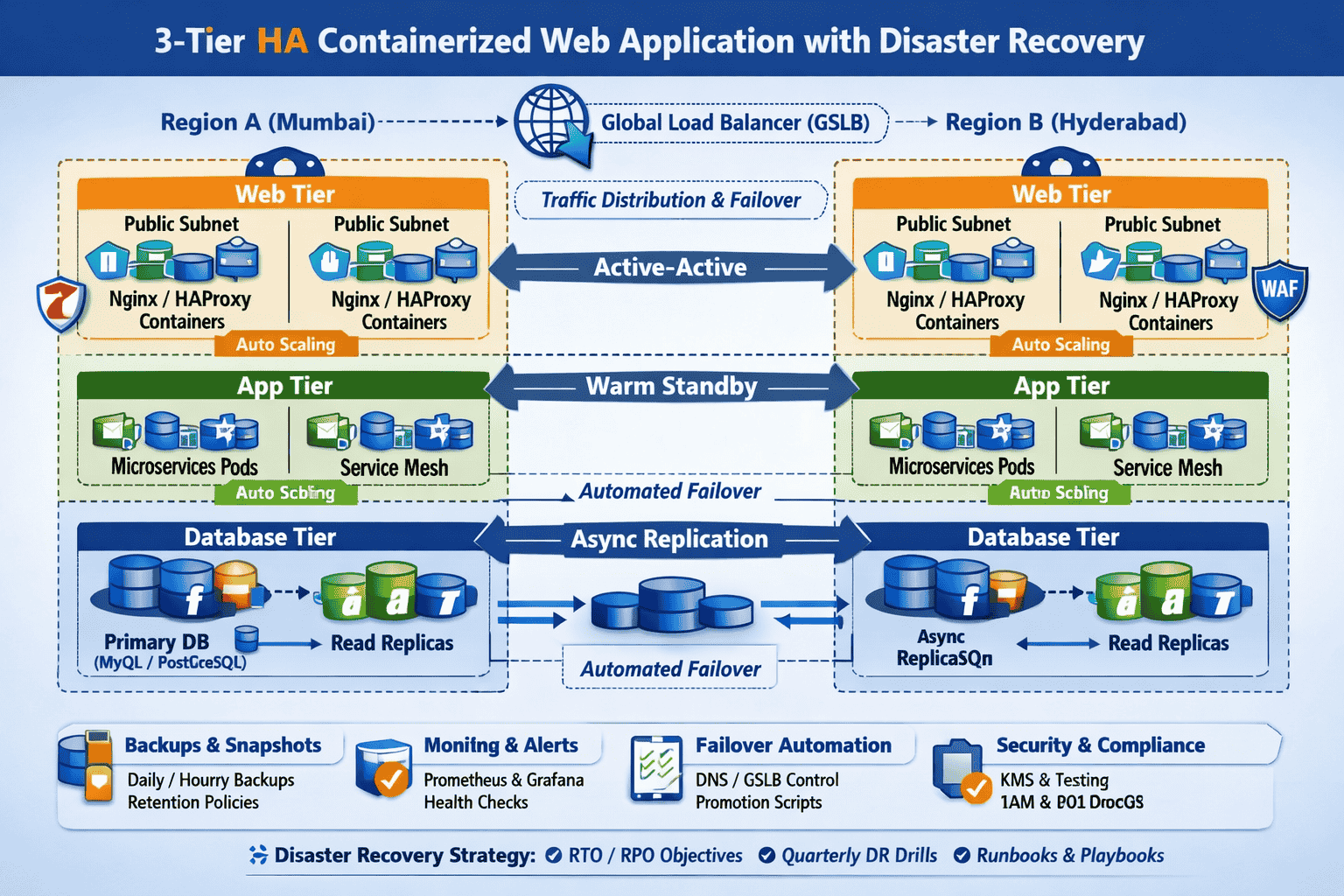
Architecture Overview
Traffic enters via a Global Server Load Balancer (GSLB) that distributes requests across Region A and Region B. Each region contains public and private subnets: web tier in public subnets, application tier in private subnets, and database tier in private subnets with multi‑AZ replication. Shared services include object storage for static assets, centralized monitoring and logging, and automated backup and recovery.
| Tier | Components | Availability & Scaling | Notes |
|---|---|---|---|
| Presentation Layer | Global Load Balancer; Ingress (NGINX/HAProxy) containers; Public Subnets | Auto‑scaling web pods; multi‑AZ node pools | SSL termination at LB; health checks; WAF |
| Application Layer | Kubernetes microservices; Service Mesh (Istio/Linkerd); Private Subnets | Horizontal Pod Autoscaler; multi‑AZ nodes | Circuit breaking, retries, observability via sidecars |
| Database Layer | Primary DB cluster (MySQL/Postgres) + read replicas; StatefulSets or managed DB | Multi‑AZ primary with synchronous or semi‑sync replication; read replicas for scale | Automated failover; backups and point‑in‑time recovery |
Region and Network Topology
Deploy identical Kubernetes clusters in two regions (Region A and Region B). Within each region use multiple availability zones and separate public/private subnets. Use private networking (VPC/VNet) with strict network policies and least‑privilege security groups to isolate tiers. Cross‑region traffic is limited to replication and health checks; user traffic is routed by the GSLB.
Supporting Infrastructure
| Service | Example Components | Purpose |
|---|---|---|
| Object Storage | S3 / Blob Storage | Static assets, container image backups, artifacts |
| Block Storage | Persistent Volumes (CSI) | Database storage, stateful workloads |
| Monitoring & Logging | Prometheus, Grafana, ELK/EFK | Metrics, alerts, centralized logs |
| CI/CD | GitHub Actions / Jenkins + Helm / ArgoCD | Automated builds, image promotion, GitOps deployments |
| Secrets & KMS | Vault / Cloud KMS | Secure secret storage and key management |
| Backup & Recovery | Automated snapshots, scheduled backups | Point‑in‑time recovery and cross‑region retention |
Resilience and Failover Patterns
Use active‑passive or active‑active patterns depending on RTO/RPO and regulatory constraints. For most web apps, run active services in both regions with primary writes in one region and cross‑region replication for read replicas. Implement health checks and automated failover orchestration to promote a replica to primary when needed. Use feature flags and traffic shifting to perform controlled failovers.
Traffic Management
GSLB handles DNS‑level traffic distribution and failover. Within a region, use regional load balancers and Ingress controllers to route traffic to web pods. Configure weighted routing and health probes to shift traffic gradually during maintenance or incidents.
Data Consistency and Replication
Choose synchronous replication for strong consistency (higher latency) or asynchronous/semi‑sync for lower latency with potential data lag. Keep write‑master in a single region if regulatory residency or latency constraints require it; replicate reads cross‑region for scale.
Security and Compliance
Enforce network policies, IAM least privilege, and encrypt data at rest and in transit. Store KMS keys and backups in the same legal jurisdiction when data residency rules apply. Use WAF, DDoS protection, and regular vulnerability scanning for container images and runtime workloads.
Observability and Operations
Centralize metrics, traces, and logs. Configure alerting with runbooks and automated remediation where possible. Run regular DR drills, test failover and failback procedures, and validate backups with restore tests.
CI/CD and Deployment Strategy
Adopt GitOps or pipeline‑driven deployments. Build immutable container images, push to a private registry, and promote images through environments. Use Helm charts or Kustomize for reproducible manifests and Terraform for infrastructure provisioning.
# Example: Minimal Kubernetes Ingress + HPA snippetapiVersion: networking.k8s.io/v1kind: Ingressmetadata: name: web-ingressspec: rules: - host: example.com http: paths: - path: / pathType: Prefix backend: service: name: web-service port: number: 80---apiVersion: autoscaling/v2kind: HorizontalPodAutoscalermetadata: name: web-hpaspec: scaleTargetRef: apiVersion: apps/v1 kind: Deployment name: web-deployment minReplicas: 3 maxReplicas: 20 metrics: - type: Resource resource: name: cpu target: type: Utilization averageUtilization: 60Operational Playbook (Summary)
1) Monitor health and set SLOs; 2) Automate backups and test restores; 3) Run scheduled failover drills; 4) Keep IaC and manifests in Git; 5) Enforce security scanning and runtime policies; 6) Document failback steps and runbook owners.
Design Tradeoffs and Recommendations
| Decision | Tradeoff | Recommendation |
|---|---|---|
| Active‑Active vs Active‑Passive | Active‑active reduces RTO but increases complexity and cost | Use active‑active for mission‑critical services; active‑passive for cost‑sensitive workloads |
| Synchronous vs Asynchronous DB Replication | Synchronous ensures consistency but adds latency | Prefer asynchronous for geo‑replication unless strict consistency is required |
| Managed DB vs Self‑Managed | Managed reduces ops burden but may limit custom tuning | Use managed DB for most teams; self‑managed only when specific controls are required |
Further Implementation Checklist
- Provision multi‑AZ Kubernetes clusters in both regions
- Configure GSLB with health checks and weighted routing
- Implement service mesh for traffic control and observability
- Use PVs/CSI drivers for stateful workloads and ensure snapshot policies
- Centralize logs and metrics; configure alerts and runbooks
- Automate backups, test restores, and document failback
- Enforce secrets management and KMS key residency
References and Next Steps
Map this architecture to your cloud provider's managed services (EKS/AKS/GKE, RDS/Cloud SQL, S3/Blob) and create a phased rollout plan: proof of concept in one region, add cross‑region replication, then enable GSLB and DR drills.