Kubernetes Dynamic Storage Provisioning with StatefulSets
The Mechanics of Persistent Volumes in Kubernetes
One of the most common questions in Kubernetes storage management is how space is utilized between PersistentVolumes (PV) and PersistentVolumeClaims (PVC). By default, Kubernetes maintains a strict 1:1 binding. If you create a 10GB PV and a PVC claims only 4GB, the remaining 6GB remains locked and unavailable to other claims, as the PV is marked as 'Bound'.
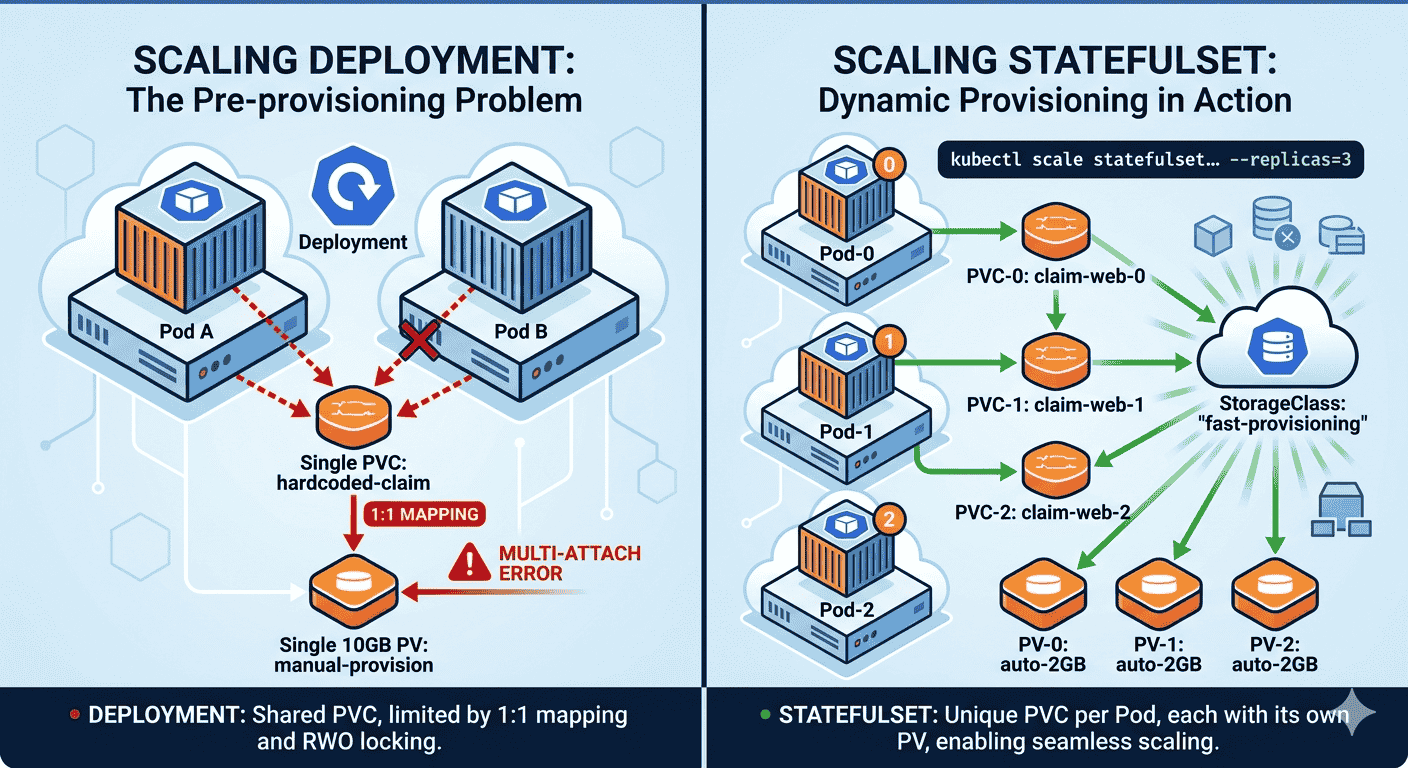
The 1:1 Binding Limitation
Because of the strict 1:1 mapping, pre-provisioning multiple PVs for a single Deployment doesn't work as expected. A Deployment uses a single PVC name for all its replicas. Since that one PVC can only bind to one PV, all your pods will attempt to mount the exact same volume, leading to 'Multi-Attach' errors or data corruption if the storage is not designed for shared access.
Scaling Storage with StatefulSets
When scaling applications that require unique storage for each instance, such as databases, standard Deployments fall short because they share the same PVC. StatefulSets solve this through volumeClaimTemplates, which automate the provisioning of unique disks for every new replica.
Why Deployments Cannot Pre-Provision for Scaling
| Constraint | Deployment Behavior | Impact |
|---|---|---|
| Hardcoded PVC | All replicas use the exact same PVC name. | They all compete for the same single PV. |
| 1:1 Mapping | PVC binds to exactly one PV. | You cannot 'pre-create' 5 PVs and hope 5 replicas find them. |
| Node Locking | RWO volumes lock to a single worker node. | Replica 2 on Node B cannot mount the PV held by Node A. |
Dynamic Provisioning Workflow
| Component | Role in Provisioning |
|---|---|
| StorageClass | The blueprint that defines which storage driver (AWS EBS, GPD, etc.) to use. |
| volumeClaimTemplates | The template within a StatefulSet that triggers a new PVC for every replica. |
| PVC | The specific request generated for each pod (e.g., data-web-app-0, data-web-app-1). |
| CSI Driver | The interface that communicates with the Cloud Provider to create the physical disk. |
Implementation: StatefulSet YAML Example
To enable dynamic provisioning such that scaling up automatically creates new storage, use the following configuration structure:
apiVersion: apps/v1kind: StatefulSetmetadata: name: web-appspec: serviceName: "nginx" replicas: 2 selector: matchLabels: app: nginx template: metadata: labels: app: nginx spec: containers: - name: nginx image: nginx:latest volumeMounts: - name: www mountPath: /usr/share/nginx/html volumeClaimTemplates: - metadata: name: www spec: accessModes: [ "ReadWriteOnce" ] storageClassName: "fast-provisioning" resources: requests: storage: 2GiWhat Happens During Scaling?
When you run a command like kubectl scale statefulset web-app --replicas=3, Kubernetes triggers a specific sequence to ensure storage integrity:
- Pod Creation: Kubernetes identifies that 'web-app-2' (the third pod) needs to be created.
- PVC Generation: Before the pod starts, Kubernetes generates a unique PVC named 'www-web-app-2' based on your template.
- Automatic Provisioning: The StorageClass notices the new PVC, contacts the cloud API, and creates a new physical 2GB disk.
- PV Creation: A PersistentVolume (PV) is automatically created and bound to that specific PVC.
- Pod Startup: Only after the storage is ready will 'web-app-2' start and mount its own unique 2GB volume.
Key Benefits of StatefulSet Provisioning
| Benefit | Description |
|---|---|
| Unique Identity | If a pod dies and restarts, Kubernetes ensures it reconnects to its specific volume. |
| No Manual Work | Eliminates the need to pre-create hundreds of PVs manually for large clusters. |
| Decoupled Lifecycle | PVCs remain intact after pod deletion, preventing accidental data loss. |
Deployment vs. StatefulSet Scaling
| Feature | Deployment + PVC | StatefulSet + Template |
|---|---|---|
| Storage Mapping | All replicas share 1 PVC | Each replica gets 1 unique PVC |
| Scaling Behavior | Pods compete for same disk space | New PV is provisioned for every new pod |
| Access Mode | Often requires ReadWriteMany | Works perfectly with ReadWriteOnce |
| Best Use Case | Stateless Apps / Shared Config | Databases / Distributed Systems |
Key Takeaways
- Kubernetes PV-PVC binding is 1:1; you cannot 'slice' a single PV into multiple PVCs.
- Pre-provisioning fails for Deployments because they lack unique pod identities to link to unique PVs.
- Dynamic Provisioning via StorageClasses eliminates the need to manually pre-create PVs.
- StatefulSets are mandatory when scaling workloads that require independent data persistence for each pod instance.